Flabs
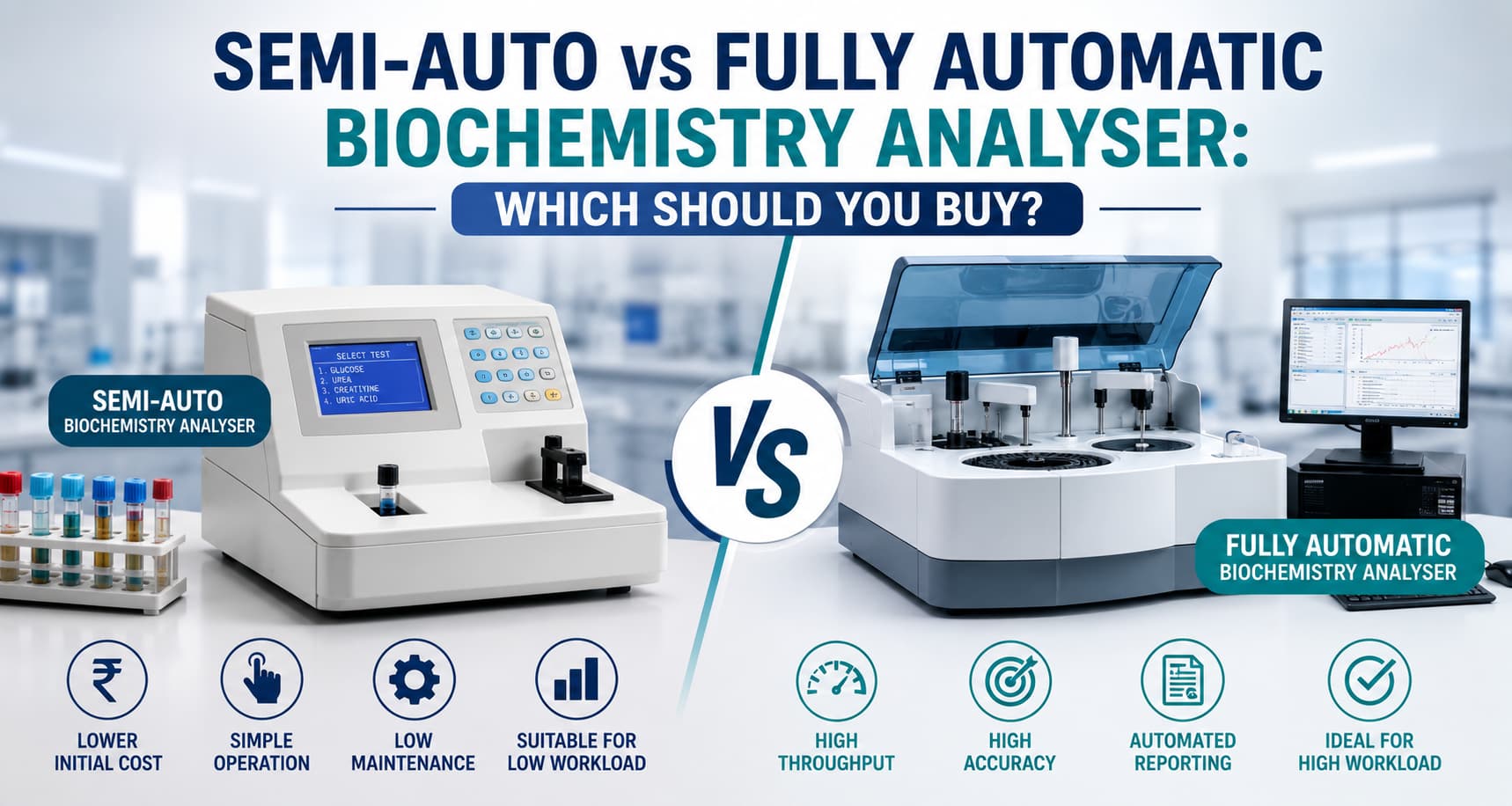
Semi-Auto vs Fully Automatic Biochemistry Analyser: Which Should You Buy?

Buying a biochemistry analyser is not a small decision. It affects your lab's daily capacity, staff's load, turnaround times, and your bottom line. The market gives you two broad choices: semi-automatic and fully automatic. Both do the same core job. They measure biochemical markers in blood, urine, or other body fluids. But the way they do it and the kind of lab they suit are very different.
For diagnostic labs, making the right decision when getting a biochemistry analyser is important. So, semi-auto or fully automatic? Which one to buy? Let us give you a direction.
Semi-Auto vs Fully Automatic Biochemistry Analyser
| Parameter | Semi-Automatic | Fully Automatic |
|---|---|---|
| Sampling Method | Manual addition of samples | Automatic sampling (auto-sampler) |
| Number of Samples per Run | ~40 samples | ~200-300 samples per run |
| Throughput / Speed | Low throughput | High throughput (≈240-300 tests/hour) |
| Measurement Time | ~5-6 minutes per sample | ~0.6 seconds per sample (≈200 samples in ~2 hours) |
| Working Mode | Batch processing only | Random access (multiple tests simultaneously) |
| Human Intervention | High (manual steps required) | Minimal or no manual intervention |
| Accuracy & Reliability | More prone to human error | Higher accuracy due to automation |
| Sample Handling Capacity | One sample at a time | Multiple samples simultaneously |
| Cleaning Function | Manual cleaning required | Automatic self-cleaning system |
| Temperature Control | Needs an external water bath | Built-in temperature control |
| Additional Equipment | Requires centrifuge + water bath | Requires a centrifuge only |
| Sample & Reagent Volume | Larger volume required | Smaller volume required |
| Labor Requirement | Higher (manual work involved) | Lower (automated workflow) |
| Analysis Speed | Slower | Much faster |
| Workload & Data Storage | Limited capacity | High workload & larger data storage |
| Convenience | Less convenient | More convenient and user-friendly |
| Major Limitation | Higher operating errors due to manual handling | Higher cost but minimal errors |
Understanding the Basics
A semi-automatic biochemistry analyser requires the operator to manually pipette the sample and reagent into the cuvette, then place it in the machine. The analyser handles the optical measurement. It reads absorbance, calculates the result, and displays it. The rest is human.
A fully automatic biochemistry analyser does nearly everything on its own. You load the samples and reagents and the machine handles aspiration, mixing, incubation, measurement and result output without manual steps.
That one difference in manual involvement changes the cost, throughput, error risk, and staffing requirement entirely.
Semi-Auto Analyser: Working Principle & Uses
The semi-auto analyser working principle is based on photometry. The operator mixes the sample with a specific reagent manually. Then the operator introduces the mixture into the cuvette compartment.
The machine passes a beam of light through the sample at a defined wavelength. It measures how much light gets absorbed (absorbance) and converts that into a concentration using pre-set calibration data.
Some models also support kinetic assays for enzyme measurement and turbidimetry for certain protein tests.
Semi-Auto Analyser Uses
- Small to mid-sized labs with sample volumes under 100 tests per day.
- Labs running a focused test menu, e.g., lipid profiles, liver function tests, kidney panels, blood glucose, etc.
- Clinics and nursing homes where the budget is the primary constraint.
- Labs in Tier 2 and Tier 3 cities where fully automated systems may be over-specified.
They are also a practical backup unit in larger labs, useful during peak load or when the primary analyser needs maintenance.
What You Give Up
Manual pipetting introduces human error. A slightly off pipette volume, a miscalculated dilution, or a contaminated cuvette can affect results. Run-to-run consistency depends heavily on the operator. You also cannot walk away during a run. Someone has to be present for every test.
Fully Automatic Biochemistry Analyser
A fully automatic system loads, processes, measures, and reports without operator intervention mid-run. Modern fully automatic analysers can handle anywhere from 200 to 1,000+ tests per hour, depending on the model and configuration.
Where It Clearly Wins
- High-volume labs: Reference labs, hospital labs, and collection centres with 500+ tests daily cannot rely on manual pipetting. The throughput just isn't there with semi-auto systems.
- Consistency: Automated aspiration and dispensing eliminate the pipetting variability that affects semi-auto results. Every sample gets the same volume, the same mix time, and the same incubation.
- Expanded test menus: Fully automatic analysers handle immunoturbidimetry, HbA1c (on compatible models), electrolytes, and speciality panels alongside routine biochemistry.
- Reduced staffing burden: One trained operator can oversee a fully automatic system running hundreds of tests simultaneously, freeing up staff for other tasks.
- STAT capability: Most fully automatic models allow urgent samples to be prioritised mid-run without stopping the batch.
What are the Costs Involved?
Biochemistry analyser price in India varies significantly between the two categories.
ntry-level semi-auto analysers start at approximately ₹30,000 to ₹80,000. Mid-range models with better optics and more parameters go up to ₹1.5 lakh. The reagent cost per test is also lower because you control the volumes precisely.
Fully automatic analysers begin at around ₹5 lakh for basic closed-channel models and can go well above ₹50 lakh for high-throughput, open-channel systems with ISE modules. Factor in reagent costs (which are higher on a per-unit basis for many closed systems), annual maintenance contracts, calibrators, and quality control consumables.
The real question around semi-auto vs fully auto biochemistry analyser cost is not just the sticker price. It is the cost per reportable result. At low volumes, semi-auto is cheaper per test. Once your lab crosses a certain daily volume threshold (usually around 150-200 tests per day), the math starts favouring automation because of staff time saved and error reduction.
What to Choose Between the Two
- What is your current daily sample load? If it is under 100, a semi-auto system is adequate. Above 300, a fully automatic unit becomes a practical necessity.
- What is your test menu? A 10-15 parameter routine panel can run on semi-auto. If you plan to add specialised panels or immunoturbidimetric assays, go fully automatic.
- Do you have NABL accreditation or are you planning for it? NABL demands documented quality control and result traceability. Fully automatic systems make QC data logging easier to maintain.
- What is your staffing situation? Semi-auto requires a dedicated, skilled operator per instrument. Fully automatic frees up that capacity.
- Is this your only analyser? For labs with a single instrument, redundancy planning matters. Some labs keep a semi-auto as a backup for exactly this reason.
Ultimately, there is no single right answer. A well-run semi-auto lab serving a small patient base can deliver excellent results. A poorly managed fully automatic system can still produce bad data if QC is ignored.
The Bottom Line
The decision between semi-auto vs fully auto biochemistry analyser comes down to volume, budget, and where your lab is headed. Start with what your current load demands, not what sounds impressive on paper. Buy for the next three to five years of growth, not for today's sample count alone.
First run a proper workflow audit if you are still weighing the decision. Count your daily tests, map your peak hours, and calculate your current cost per reportable result. The numbers will tell you what the spec sheets won't.
Where Your Lab Information System Fits In
Whichever analyser you choose, the results it produces are only as useful as the system that manages, reports, and tracks them.
Flabs LIS is trusted by 2,000+ NABL-accredited labs across India. It connects directly to your biochemistry analyser and automates the steps that slow labs down.
- AI Interpretation flags abnormal results and adds contextual clinical commentary automatically.
- TAT Management tracks every test in real time, so no report misses its deadline.
- Quality Control (QC) runs automated checks against Westgard rules before any report goes out.
- AI Smart Report generates formatted reports.
- Bulk Actions over WhatsApp, SMS, or email.
- Dynamic QR Codes on every report give patients instant access to a tamper-proof soft copy.
- Lab Finance Management handles invoicing and collections with full automation.
- Multiple Referral Management tracks commission payouts and referral performance from a single dashboard.
Your analyser produces the numbers. Flabs makes sure those numbers reach the right people on time.
Get Started at ₹1!
Try Flabs for a full month for just ₹1.
Follow us on