Flabs
Doctor Referral Commission in Diagnostic Labs: The Complete Reality Check

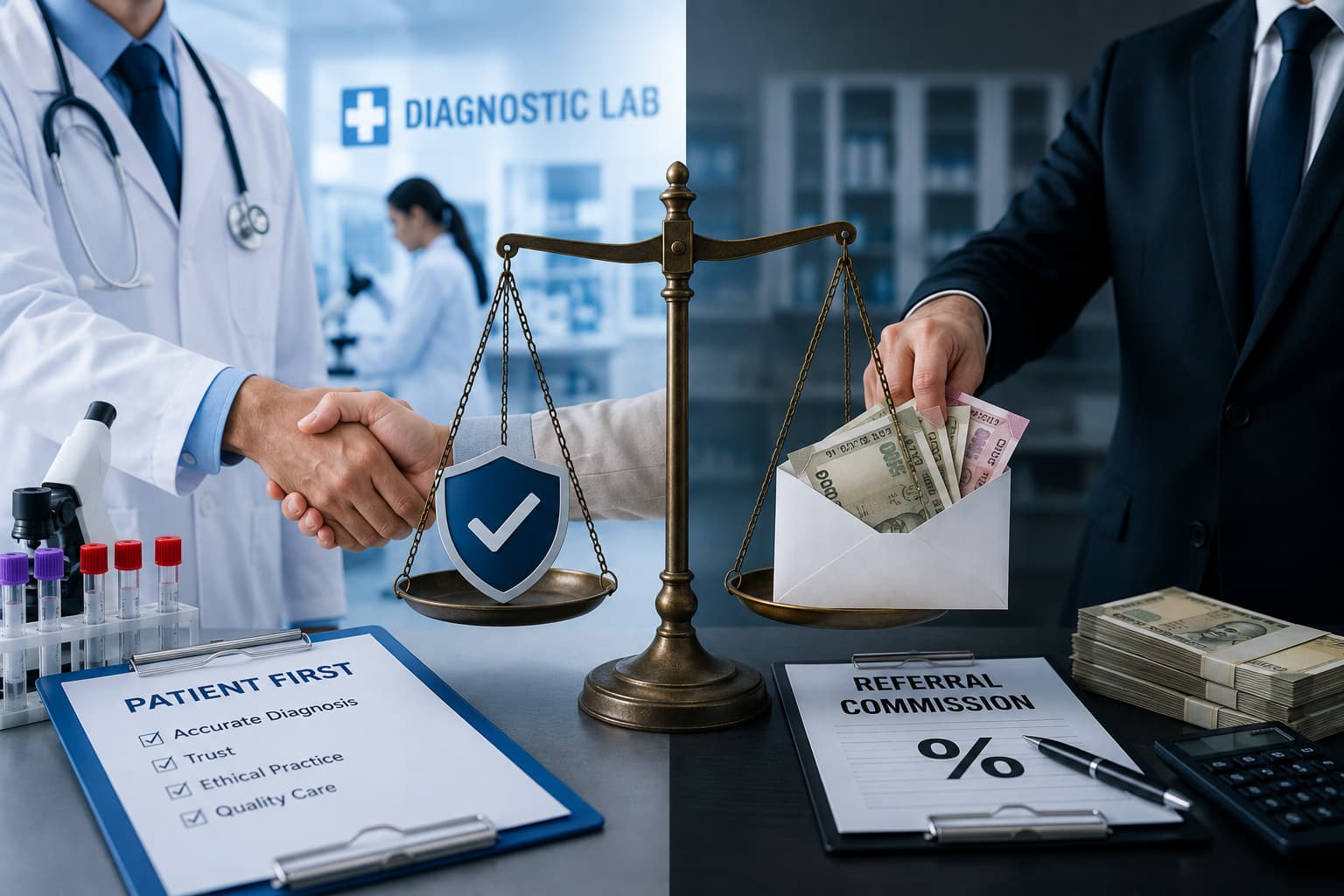
Walk into almost any diagnostic lab in India and you'll find an open secret nobody likes to say out loud. A patient gets sent for tests. The lab runs them. And somewhere in the background, money moves from the lab back to the doctor who sent that patient over. It's a quiet exchange. But it shapes how the entire diagnostics business happens.
If you're a pathologist or run a lab, you already know the pull of it. But the ground beneath these arrangements has shifted hard over the last two years. Let us look at what's real, what's legal, and what you actually need to know to run a clean lab.
What Lab Commission to Doctors in India Really Means
Lab commission to doctors in India is a payment a diagnostic lab gives a referring physician in return for sending patients its way. People call it a "cut." Some call it a referral fee. The label changes, but the mechanism is the same: money flows based on who sent the patient, not on the quality of the test.
Research published in a peer-reviewed health policy journal found that this "cut" can account for nearly 40% to 50% of the cost of diagnostics. Half the price a patient pays can disappear into a kickback. That single statistic explains why a routine test sometimes costs three times what it should.
And patients have caught on. In one large survey of roughly 29,000 people, 59% believed their doctors had ordered more tests than were actually needed. Trust erodes fast when people suspect the referral was about money instead of medicine.
So when we talk about lab commissions to doctors in India, we're really talking about a practice that inflates prices, encourages over-testing, and damages the credibility of the whole profession.
Is It Legal? The Short Answer Is No
A lot of lab owners operate as if the rules are vague. They aren't.
The practice was already barred under the Indian Medical Council. These rules prohibited doctors from such practices long before anyone treated it as a serious risk. The problem was enforcement.
That gap has narrowed. The National Medical Commission notified its Registered Medical Practitioner (Professional Conduct) Regulations in August 2023. These carry a clear “prohibition on accepting commissions from diagnostic centers, medical equipment suppliers, and similar entities for referrals or endorsements.“
Legal analysts noted the new rules make the prohibition on commissions for referrals even more stringent than what came before.
The courts back this up too. The Supreme Court in the Apex Laboratories case held that freebies given to doctors exposed those doctors to sanctions, including a ban on their practice of medicine. Giving the inducement was itself prohibited because receiving it was. In plain terms: both sides of the deal carry exposure.
Income Tax raids on labs have also surfaced enormous sums. In one Bengaluru case, reports suggested the referral fees at a single laboratory exceeded Rs 200 crore. That isn't a slap on the wrist. That's financial reckoning.
Why Many Labs Still Do It
If it's banned and risky, why does it persist? Because the structural pressure is real. Pretending otherwise gets nobody anywhere.
The diagnostics market is crowded and lightly governed. India has no exhaustive, all-encompassing regulation governing labs, which left a vacuum where these arrangements grew unchecked. In that vacuum, a new lab faces a brutal math problem: doctors hold the patient relationships, and competitors are already paying for those relationships. Refuse to play and your samples dry up.
Quality compounds the issue. Of around 1,000 diagnostic laboratories cited in one Delhi petition, only about 10% held NABL accreditation.
When most labs can't compete on accredited quality, they compete on commission instead. The incentive distorts everything.
The Real Cost
| Factor | What Commission Promises | What It Delivers |
|---|---|---|
| Patient volume | Steady referral flow | Volume that vanishes the moment a competitor pays more |
| Margins | More tests, more revenue | Up to 40–50% of revenue handed back as the cut |
| Doctor loyalty | A reliable referral base | Loyalty rented, never owned |
| Legal standing | “Everyone does it” | Direct breach of NMC 2023 rules and tax law |
| Reputation | Growth | Patient distrust; 59% already suspect over-testing |
What Smart Labs Should Do
Compete on turnaround and accuracy: Doctors send patients to labs they trust. Fast, reliable reports build a referral base that doesn't evaporate when someone else offers a bigger cut.
Get accredited: With only a small fraction of labs holding NABL accreditation, it's a genuine differentiator.
Be transparent on pricing: When patients see a fair price unbloated by a hidden cut, they come back and tell others.
Bring structure: Track where samples come from, measure report quality, and build relationships on service.
Where Technology Fits In
Moving away from doctor referral commission in labs isn't only an ethics decision. It's an operations decision. The right systems make the clean path the easier path.
A modern lab information system lets you see your referral data honestly. Which physicians send quality samples? Where do reports get delayed? Which test lines actually drive revenue? Once you can answer those questions, you stop guessing and start building real relationships.
Good software also tightens the things doctors notice: faster turnaround, fewer errors, cleaner reports delivered on time. Those are the things that earn a referral no commission can buy.
It's worth being honest that doctor referral commission in labs grew partly because labs lacked the tools to compete any other way. Remove that limitation and the calculation changes. You no longer have to pay for loyalty when your service quality earns it.
The Bottom Line
Lab commission to doctors in India is widespread. It is now squarely illegal under the NMC 2023 regulations.
The good news is that the exit ramp is also the smarter business. Labs that invest in accreditation, transparent pricing, and disciplined referral management in labs end up with something the commission-payers never get: a referral base that stays loyal because the service is good, not because the payment was generous.
Streamline Doctor Referrals with a Smarter Digital System
Managing doctor referrals manually can lead to leakage, lack of transparency, and compliance risks. A structured digital system helps labs track referrals, improve reporting efficiency, and maintain ethical compliance.
Explore how modern labs are shifting from commission-based referrals to transparent digital workflows using dedicated referral management tools.
Explore Flabs Doctor Referral App
Also check -
How to Reduce Cost Per Test in Your Diagnostic Lab
How to Get More Doctor Referrals for Your Diagnostic Lab
Get Started at ₹1!
Try Flabs for a full month for just ₹1.
Follow us on