Flabs
Coulter Counter: Working Principle and Laboratory Uses

Every day, millions of blood samples move through labs across the world. Behind the accurate CBC reports your clinicians rely on sits a piece of technology that changed haematology forever: the Coulter counter.
If you run a diagnostic lab, work in haematology, or manage pathology operations, here's everything you need to know about how it works, where it applies, and what its real limitations are.
What Is a Coulter Counter?
A Coulter counter is an electronic particle counting and sizing instrument used to count and measure the size distribution of particles suspended in a fluid, most commonly blood cells. In medical labs, the Coulter counter is used to determine the number, volume, and size of red blood cells (RBCs), white blood cells (WBCs), and platelets in a blood sample.
Developed by Wallace H. Coulter in the 1950s, the device fundamentally shifted cell counting from manual microscopy to automated, high-throughput analysis. Today, it is central to Coulter counter haematology operations in hospitals, reference labs, and pathology labs in India that process thousands of samples daily.
The Coulter Counter Principle: How It Works
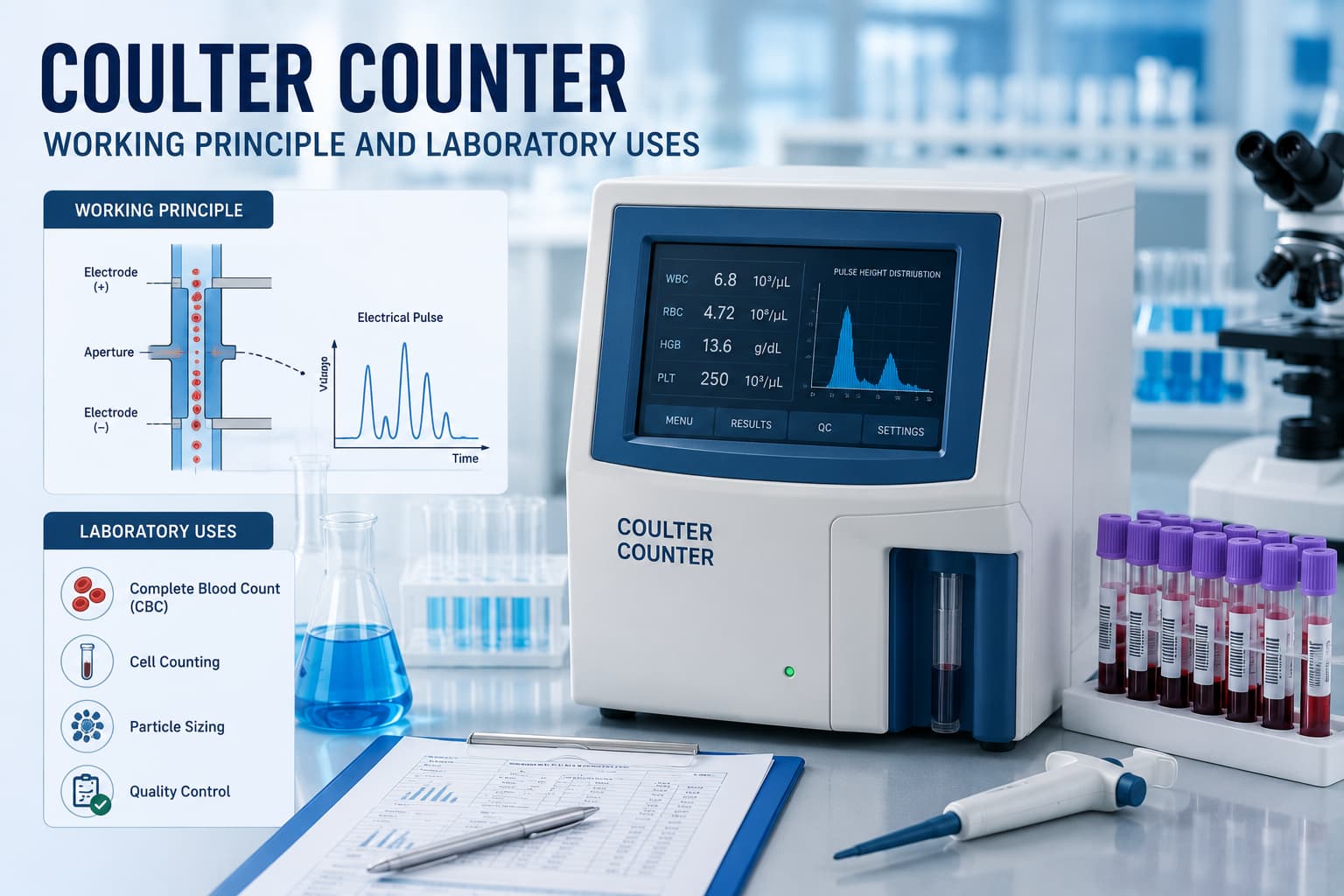
The Coulter counter principle is based on electrical impedance. It is also called the Coulter Effect.
- Sample preparation: The blood sample is diluted in an electrically conductive saline solution.
- Aperture tube: The diluted suspension is drawn through a small aperture (opening) in a tube submerged in the electrolyte solution.
- Electrical current: A constant electrical current flows between two electrodes, one on each side of the aperture.
- Impedance change: When a particle (cell) passes through the aperture, it displaces its own volume of electrolyte. This temporarily increases the electrical resistance, producing a voltage pulse.
- Pulse analysis: The amplitude of each pulse corresponds to the particle's volume.
- The number of pulses=number of particles.
- The pulse height distribution = particle size distribution.
This is why the Coulter counter technique is also called the electrical sensing zone method. It's fast, reproducible, and does not rely on optical interference. This makes it especially reliable for samples with turbidity or colour.
Coulter Counter as a Particle Size Analyser
Beyond haematology, the Coulter Counter Particle Size Analyser is extensively used in research and industrial applications. The Coulter counter method for particle size analysis measures particles ranging from 0.4 µm to 1,200 µm, depending on the aperture size used.
Unlike laser diffraction, which measures light scattering and estimates size, the Coulter method measures actual particle volume. Hence, it is the reference standard in particle sizing. It doesn't assume spherical geometry, and it measures each particle individually rather than using ensemble averaging.
The Multisizer 3 Coulter Counter is one of the most advanced versions of this instrument. It offers simultaneous multi-aperture analysis and is widely used in pharmaceutical research, cell biology, and quality control applications.
Coulter Counter Uses in Labs
| Application Area | Specific Use |
|---|---|
| Clinical Haematology | CBC: RBC, WBC, platelet count, MCV, MCH, MCHC |
| Haematology | Detecting anaemia, thrombocytopenia, and leukaemia screening. |
| Microbiology | Coulter counter bacteria: Counting bacterial cells in culture; assessing growth rates and size variation. |
| Pharmaceutical Industry | Particle size distribution of drug formulations and suspensions |
| Food Science | Cell viability in fermentation processes (yeast, bacterial cultures) |
| Environmental Testing | Analysis of particle contamination in air and water; detection of biological particulates. |
| Research & Cell Biology | Cell proliferation and cell cycle studies; measuring cell volume changes; apoptosis (cell shrinkage) and necrosis (cell swelling); studying osmotic stress response, endocytosis, phagocytosis, and disease mechanisms like cancer. |
Coulter counter applications in microbiology deserve special mention. When you need to enumerate bacteria in a culture without staining or microscopy, the Coulter counter bacteria counting method gives you rapid results. However, bacterial concentrations should be high enough and the aperture is appropriately sized (e.g., 20–30 µm).
What it Measures in a CBC
In a standard haematology run, the Coulter counter apparatus generates the following.
- Total RBC count with size distribution (MCV histogram).
- Total WBC count with or without differential (depending on instrument generation).
- Platelet count and mean platelet volume (MPV).
- Haemoglobin (measured separately via photometry in integrated analysers).
- Haematocrit calculated from RBC count × MCV.
Advanced Coulter counter haematology systems also flag abnormal cell populations, large platelets, fragmented red cells, and blasts.
Advantages and Disadvantages
Understanding the advantages and disadvantages of the Coulter counter method is essential before deciding where to deploy it in your lab.
| Advantages | Disadvantages |
|---|---|
| High throughput. It processes large sample volumes quickly. | Cannot distinguish particles of similar size (e.g., platelets vs debris). |
| Strong precision and reproducibility (low CV for RBC/WBC counts). | Coincidence error when multiple particles pass together. |
| Measures actual particle volume rather than optical estimates. | Requires dilution, which can impact accuracy. |
| Supports a wide particle size range. | Risk of clogging with viscous or aggregated samples. |
| Reduced operator dependency compared to manual methods. | No morphological insights like cell structure or nucleus detail. |
| Suitable for clinical, research, and industrial use. | Requires regular cleaning and calibration. |
The inability to provide morphological detail is its most significant clinical limitation. A Coulter counter can flag an abnormal WBC count, but it cannot tell you the cell's nuclear segmentation, cytoplasmic granularity, or morphological class with certainty. That distinction requires a peripheral smear review.
Calibration and Quality Control
- Daily QC runs using commercially prepared control blood (low, normal, high levels).
- Calibration verification using certified reference materials at defined intervals.
- Aperture maintenance: Regular back-flushing and chemical cleaning to prevent partial blockages.
- Linearity checks.
In NABL-accredited labs, all of the above must be documented, traceable, and available for audit. Skipping QC or running samples during instrument drift is one of the most common sources of pre-analytical and analytical error in haematology.
Bottom Line
The Coulter counter changed laboratory medicine by turning subjective cell counting into an objective, reproducible, high-throughput process. Its principle of electrical impedance is elegant in its simplicity and powerful in its output. From routine CBC testing in pathology labs in India to advanced Coulter counter particle size analyser applications in pharmaceutical research, its footprint spans clinical and industrial science.
Its limitations are manageable when labs pair it with rigorous QC practices and a reliable LIS.
If you're running a lab that processes haematology at scale, the Coulter counter isn't going anywhere. What changes is how intelligently you manage the data it produces.
The Role of LIS in Coulter Counter-Based Labs
Running a Coulter counter well is one part of the equation. Integrating it with a lab information system (LIS) that captures, validates, and delivers results accurately. That's the other.
Run Your Data Through a Smarter LIS
FLABS is an AI-powered LIS trusted by 2,000+ NABL-accredited labs across India.
When your Coulter counter generates results, FLABS takes over with powerful features: AI Flagger, AI Interpretation, Quality Control (QC), TAT Management, Bulk Actions over WhatsApp, SMS, and email, Dynamic QR Code & Barcode for reports, and AI Voice Reporting to dictate haematology findings.
Upgrade your lab operations with a 5-Day Free Trial and see how FLABS transforms your lab operations.
Get Started at ₹1!
Try Flabs for a full month for just ₹1.
Follow us on